Before asking whether a skincare study looks convincing, identify its experimental setting. Who entered, which area received treatment, what served as the comparison, and what counted as improvement? Those questions establish the meaning of a result before a reader considers a product. This article uses the retinol arm-skin experiment to work through that process, separating the reported observations from our methodological interpretation.
Start with the study facts below, then read the results table with its analysis label intact. A number without its population, measurement unit or missing-data method is an incomplete description. Our aim is to make the reasoning inspectable: how a comparison supports an inference, which alternative explanations remain possible, and what additional evidence a broader claim would require. None of the experimental concentrations or exposure descriptions is a personal treatment schedule.
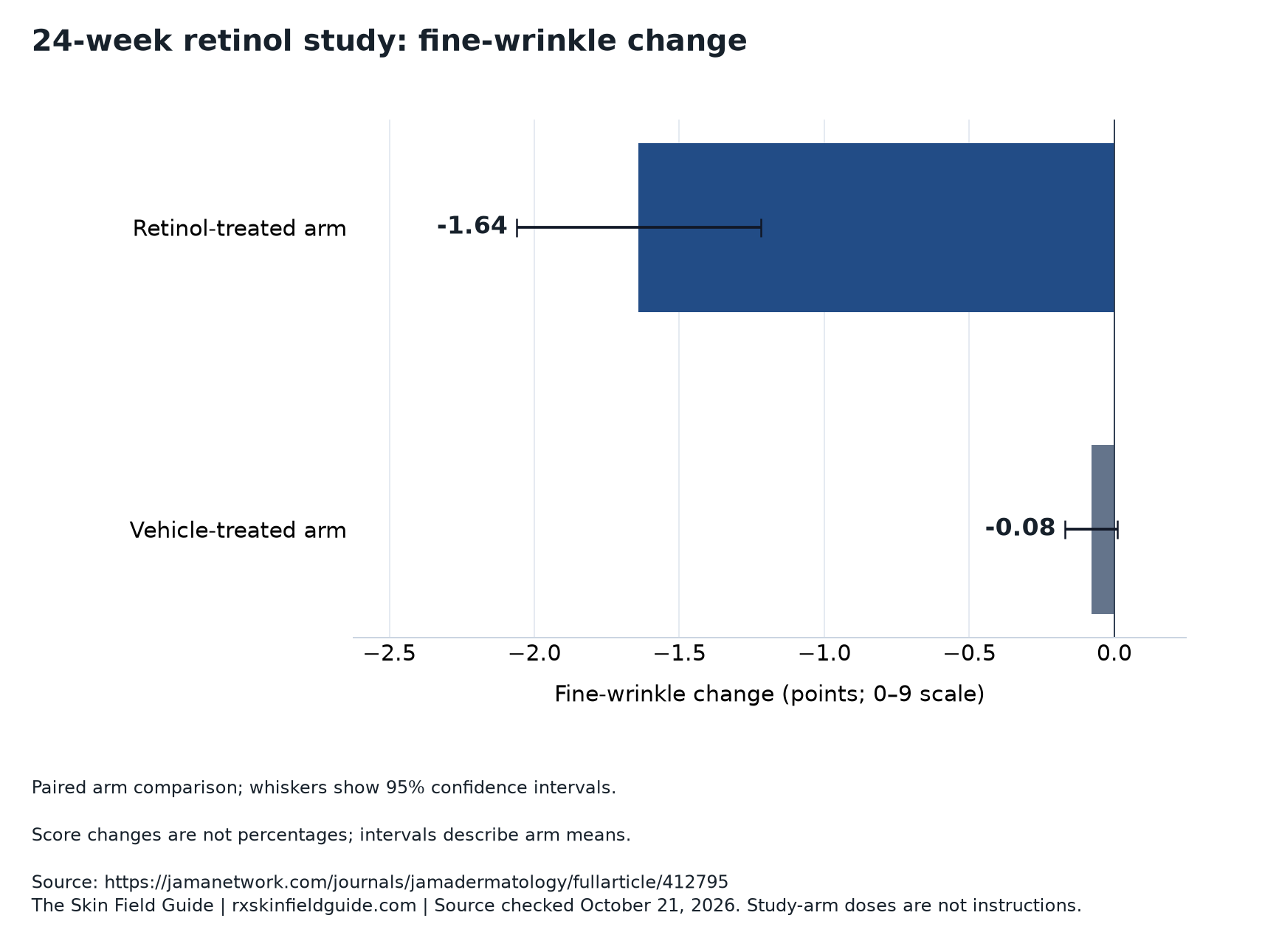
24-week retinol study: fine-wrinkle change
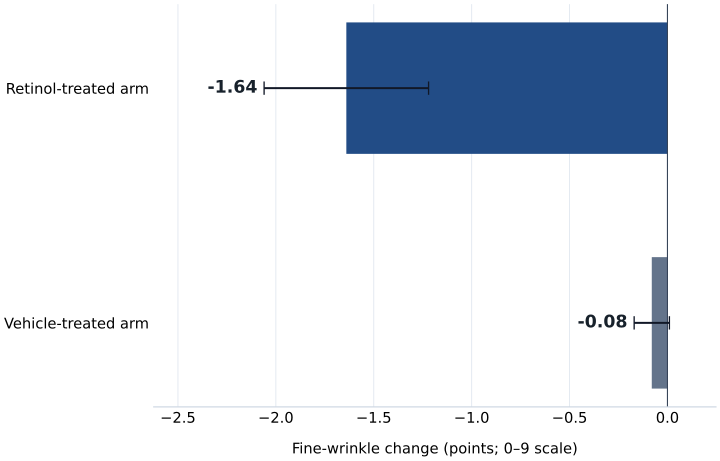
Paired arm comparison; whiskers show 95% confidence intervals.
Score changes are not percentages; intervals describe arm means.
Download the source-labeled chart (PNG) · Download the data (CSV) · Download the chart (SVG)
| Study group | Reported value | 95% confidence interval |
|---|---|---|
| Retinol-treated arm | -1.64 | -2.06 to -1.22 |
| Vehicle-treated arm | -0.08 | -0.17 to 0.01 |
Sections in this article
The population defines the first boundary of inference
Our interpretation begins with a distinction between a useful experiment and a representative sample. A narrowly defined group can help investigators answer a focused question while leaving substantial uncertainty about other groups. Readers should not treat a precise result within one setting as equally precise everywhere. Age, skin characteristics and living circumstances are dimensions to examine, rather than details that disappear after the introduction. The mature-skin guide offers a place to organize product questions without turning that category into a single research population.
Consider a hypothetical extension: an investigator wants to apply an arm-skin result to a younger person's facial concern. That proposal changes the population and the anatomical site simultaneously. A new experiment could hold one constant while testing the other, making the source of any difference easier to investigate. Simply relabeling the existing result would answer neither question. Anatomical location belongs in an evidence description just as the ingredient does. This is a framework for designing the next study, not a claim that any particular subgroup would necessarily respond better or worse.
The person and the treated area are different counting units
In a paired experiment, two observations from one person are connected. Our statistical reading therefore starts with the person as the independent unit, even though treatment is applied to separate areas. Counting each area as an unrelated participant would create the appearance of more independent evidence than the design supplies. A useful hypothetical worksheet would give each person one row, with separate columns for each area's change, followed by a column containing the difference between those changes.
That final column asks a different question from whether an area improved over time on its own. A before-and-after comparison could reflect several influences acting together; a comparison with a vehicle asks what differs when the active component is introduced within the tested preparation. Vehicle means the comparison base, not necessarily an absence of skincare. Random assignment addresses treatment allocation, while masking addresses what participants or assessors know. Neither term should be used as a substitute for the other. Our review methodology is the relevant companion when deciding which kind of evidence a product statement actually needs.
An exposure plan is different from delivered exposure
Actual exposure averaged 1.6 applications weekly; the planned maximum was three. Interpreting an average requires care: it is a group summary, not a schedule used identically by everyone. As a hypothetical arithmetic example, two people receiving different numbers of applications could produce the same average as two people receiving similar numbers. Without individual histories, an average cannot reveal the distribution. It also cannot identify which personal schedule would optimize benefit or tolerability.
Our methodological interpretation is that benefit and burden should be evaluated together under the conditions actually tested. It would be speculative to assume that increasing exposure must increase useful improvement, or that fewer applications must preserve the same outcome. The withdrawal information in the study facts deserves attention alongside the result, rather than being hidden by a favorable adjective. For documentary comparisons, the Curology Custom Formula Rx review provides a place to check stated formulation and service terms. Linking that record does not establish a match to the experiment or a promise of its results.
Read the result in score points before assigning meaning
Fine-wrinkle scores favored retinol; the analysis included all 36 using last observation carried forward. Our interpretation of a severity score starts with the direction: movement toward the lower end denotes less severity on that scale. A score difference does not count how many wrinkles disappeared, measure a percentage of skin restored, or state how many people experienced a personally worthwhile benefit. Those would require different definitions and, in some cases, different measurements. Decimal precision should not obscure the distinction between a rating and a physical count.
For an illustration unrelated to these participants, imagine a rating declining from six points to four. The change is minus two points. Calling that one-third fewer wrinkles would introduce a new physical meaning that the arithmetic does not establish. Likewise, an average improvement could arise from similar changes across participants or from a mixture of large and small changes. A group estimate alone does not reveal that pattern. The fine-lines guide can help frame the outcome someone wants to discuss, but a personal goal still needs to be distinguished from the study's scoring system.
| Question | Information needed | Interpretation |
|---|---|---|
| How much did severity change? | Scale, direction and observation time | Movement on a rating scale is not a count of physical wrinkles. |
| How many people benefited? | Individual outcomes and a defined benefit threshold | A group mean does not count responders. |
| How precise is the paired contrast? | Within-person differences and their uncertainty | Separate arm summaries cannot supply a paired confidence interval. |
Error bars require an analysis label
Original Figure 2 instead shows 23 completers with standard-error bars. A standard error describes uncertainty in an estimated mean; a confidence interval uses an additional statistical construction to express an interval estimate. Neither is the spread of every individual's response. Readers should first ask what an error bar represents, then which observations generated it. Otherwise, two visually similar graphics can be mistaken for the same analysis even when they answer different questions.
Our reasoning about paired comparisons adds another requirement. Uncertainty in a difference depends on how the two measurements vary together within people. Subtracting the outer endpoints of two separately reported confidence intervals does not recover a valid confidence interval for that paired difference. Imagine two hypothetical datasets with identical averages and similar variability on each side, but different relationships between the sides within each person. Their uncertainty about the paired contrast could differ. The appropriate calculation needs that relationship, not just the displayed arm summaries. The source register is useful for checking a figure's underlying record instead of treating its appearance as sufficient documentation.
Missing observations change what a final estimate represents
Last observation carried forward is a rule for filling a later missing value with an earlier recorded value. Our interpretation is that this preserves a place in the analysis, not a newly observed outcome. It should be distinguished from following every participant through the final visit. A completed spreadsheet can contain both direct measurements and substituted values; the visual completeness of its rows does not remove that difference in evidence.
Consider an invented participant whose last recorded score is five and whose later score is unknown. Carrying five forward creates a particular representation of that missing visit. If the unobserved value would have been four, that representation differs in one direction; if it would have been six, it differs in the other. The example illustrates why the rule is not automatically conservative. For a future analysis, useful sensitivity checks would vary plausible missing outcomes and examine whether the main interpretation changes. The reasons people leave also matter: the goal is to understand whether missingness could be connected with benefit, burden or unrelated circumstances, rather than to assume all missing observations have one explanation.
A laboratory signal and a clinical explanation need separate tests
Only statistically significant biopsy effects were reported: glycosaminoglycans, n=6; procollagen I, n=4. Our interpretation separates three questions: whether a laboratory measurement changed, whether the change caused an appearance outcome, and whether it predicts a functional health benefit. Evidence for the first question does not answer the other two automatically. A possible mechanism can guide future research without becoming an established account of why every participant responded.
Selective presentation creates a further interpretive problem. As a hypothetical example, if several assays are explored but a reader sees only those crossing a statistical threshold, the visible record is not a neutral inventory of everything tested. An informative next report would show all planned measures, their sample sizes and estimates, including inconclusive results. To investigate clinical mediation, researchers would also need a design linking changes in the proposed mediator to changes in the clinical endpoint while addressing competing explanations. To claim injury or ulcer prevention, they would need clinical injury or ulcer outcomes. A promising laboratory story is a reason to define such a test clearly, not permission to replace it.
Place neighboring tretinoin evidence in its own setting
The comparison below maps different evidence records; it is not an efficacy ranking. Our synthesis treats ingredient identity, preparation, population, skin site and endpoint as separate matching requirements. A shared interest in wrinkles does not make studies interchangeable. A longer observation period can answer a duration question within its own experiment, but it cannot repair a mismatch in ingredient or formulation. The tretinoin concentration article examines the concentration comparison in greater detail.
The current RENOVA 0.02% label states that safety and effectiveness above age 71 and daily use beyond 52 weeks are not established. It prohibits use during pregnancy or attempts to conceive and describes local irritation and heightened sunburn susceptibility. Those statements concern that medicine. Our interpretation is that current labeling must remain distinct from historical research, including research on another ingredient. Neither a favorable result elsewhere nor an author's discussion can silently expand a medicine's labeled evidence. A clinician evaluating a particular product needs its own formulation and current instructions; this article supplies a way to compare evidence, not a substitution rule.
| Record | Experimental scope | Interpretive boundary |
|---|---|---|
| 1995 tretinoin abstract | 99 completers; 48 weeks; facial photoaging; 0.1% and 0.025% creams versus vehicle. | Clinical improvement was similar; irritation was greater with 0.1%. This is not a retinol comparison. |
| 2005 tretinoin abstract | 204 participants; up to two years; facial photodamage; 0.05% emollient cream versus vehicle. | Reported improvement in clinical signs does not supply a retinol conversion or ranking. |
| Current RENOVA label | Tretinoin cream 0.02%; adjunctive mitigation of fine facial wrinkles with comprehensive skin care and sun avoidance. | Use the exact product's labeling when discussing its indication and precautions. |
Disclosures and document access belong in the evidence record
Four inventors disclosed conditional patent royalties if licensing and sales occurred. A potential financial relationship is relevant to appraisal, but it does not by itself identify who paid for a study, establish payments received, or prove that a result is incorrect. Our approach is to ask separate questions about declared interests, study funding, access to data and methodological choices. Combining them into a single assumption can obscure the particular issue a reader actually needs resolved.
This analysis uses the full publisher retinol article, including its original table footnote and financial disclosure, the indexed abstracts of the two comparison trials, and current official labeling. No supplements or individual participant data were reviewed. No separately labeled funding statement was located in the accessed retinol article; that absence does not establish that the research had no funding. These access distinctions determine which details can be checked directly. For our own publication, the ownership disclosure is a separate record. Transparency about a publication's relationships should accompany, rather than substitute for, accurate examination of the research itself.
Turn the evidence into answerable product questions
Our editorial interpretation is to use a research result as the start of a comparison record. Write down the exact claim under consideration, then identify the evidence that would test it. If the claim concerns a different formulation, ask for data about that formulation. If it concerns a different skin site or population, identify that change explicitly. If it concerns persistence after treatment ends, look for observations beginning at discontinuation rather than simply counting time since enrollment. These are different research questions, even when the product descriptions use similar language.
Commercial documentation can answer another set of questions: what is being offered, what a stated price includes, which terms govern refills, and how follow-up is described. The Nurx Tretinoin Cream review is a place to inspect those documentary questions without attributing experimental outcomes to a provider. Keep the clinical and contractual records alongside each other, with their dates and sources. A clear decision record should reveal where direct evidence ends and an assumption begins. That is more useful than compressing every uncertainty into a single product score that conceals why two options are difficult to compare.
Questions about the evidence
Does a confidence interval predict what will happen to one person?
No. A confidence interval around a group estimate describes uncertainty in estimating that quantity under the analysis assumptions. Predicting an individual's response is a different task. Our interpretation is to avoid reading the interval as a guaranteed range of personal improvement or as the fraction of people who benefited. Those claims would require information about individual outcomes and a defined prediction method.
Why does the comparison base matter?
The comparison defines the question an experiment asks. As a methodological example, testing an active preparation against its base differs from comparing two finished products or comparing treatment with no intervention. The resulting contrasts cannot simply be exchanged. Before using a result to choose between products, ask whether the actual alternatives of interest were compared and whether the outcome was measured in the same way.
Would a larger study resolve every uncertainty?
Increasing sample size can improve statistical precision under an appropriate design, but it does not automatically correct a mismatched population, an unsuitable outcome or systematic measurement bias. Our hypothetical priority would be to define the intended claim first, then design a study that tests it. More observations of the wrong endpoint can leave the clinically relevant question unanswered with great numerical precision.
What would a stronger durability study need?
Define when treatment ends, schedule later observations, explain how continued skincare is handled, and report who remains under observation at each time. Our methodological view is that a useful report should show the size and uncertainty of the remaining effect, rather than only whether a statistical threshold was crossed. A nonsignificant difference alone cannot establish that two outcomes are equivalent or unchanged.
Can ingredient percentages provide a conversion between preparations?
No conversion follows from comparing numbers printed beside different ingredient names. Our evidence framework requires the ingredient, formulation, application conditions and clinical endpoint to be matched or directly studied. Retinol and tretinoin are different substances. A numerical ratio between their listed concentrations would be arithmetic, not a validated equivalence in benefit, irritation or appropriate use. Current product information and clinical assessment remain separate requirements.
Editorial assessment
Our assessment is to read this experiment as a defined comparison with several layers of evidence: the clinical estimate, the handling of incomplete observations, and the exploratory biological interpretation. Each layer deserves its own question. Confidence should come from matching a claim to the measurement that tests it, not from the familiarity of an ingredient or the appeal of a proposed mechanism. For readers comparing skincare options, the practical value is a more precise discussion: which outcome matters, which setting the evidence represents, and which information still needs to be obtained before extending the conclusion.
Research access and limitations
Evidence access differs by record: full publisher retinol article and original clinical table footnote; indexed primary abstracts for the 1995 and 2005 tretinoin comparisons; current official RENOVA labeling. Supplements, individual data and an independent registry review were outside this analysis. Worked examples are hypothetical methodological explanations, not additional participants or observed results. Product-review links identify documentary resources and do not establish clinical equivalence or provider outcomes. This article does not provide an individualized regimen or claim medical review.
Sources and access notes
Sources checked October 21, 2026. The access notes below identify the material examined for this article.
- Improvement of naturally aged skin with vitamin A (retinol).
Full publisher research article, including original clinical table-image footnote, figure captions, Comment and Financial Disclosure; no supplements or individual data reviewed. · Checked October 21, 2026
- Two concentrations of topical tretinoin (retinoic acid) cause similar improvement of photoaging but different degrees of irritation. A double-blind, vehicle-controlled comparison of 0.1% and 0.025% tretinoin creams.
Indexed original research abstract · Checked October 21, 2026
- Long-term efficacy and safety of tretinoin emollient cream 0.05% in the treatment of photodamaged facial skin: a two-year, randomized, placebo-controlled trial.
Indexed original research abstract · Checked October 21, 2026
- DailyMed - RENOVA- tretinoin cream
Official current labeling retrieved in full · Checked October 21, 2026