A concentration printed on a tube identifies one feature of an intervention. To interpret an experiment, place that number beside the people enrolled, the skin examined, the comparison treatment and the outcome measured. These details determine what the result describes. A microscopic change, a clinician's appearance rating and an uncomfortable reaction each answer a different question, even when investigators collect them during the same visit.
This guide follows those questions through tretinoin research and two useful neighboring records: an experiment involving retinol and the labeling for a specific prescription cream. Its purpose is to make the boundaries of an observation visible. The fine-lines reference page organizes the concern; the analysis here examines how evidence about that concern is constructed. Numerical examples explicitly identified as illustrative are teaching calculations, not additional trial findings.
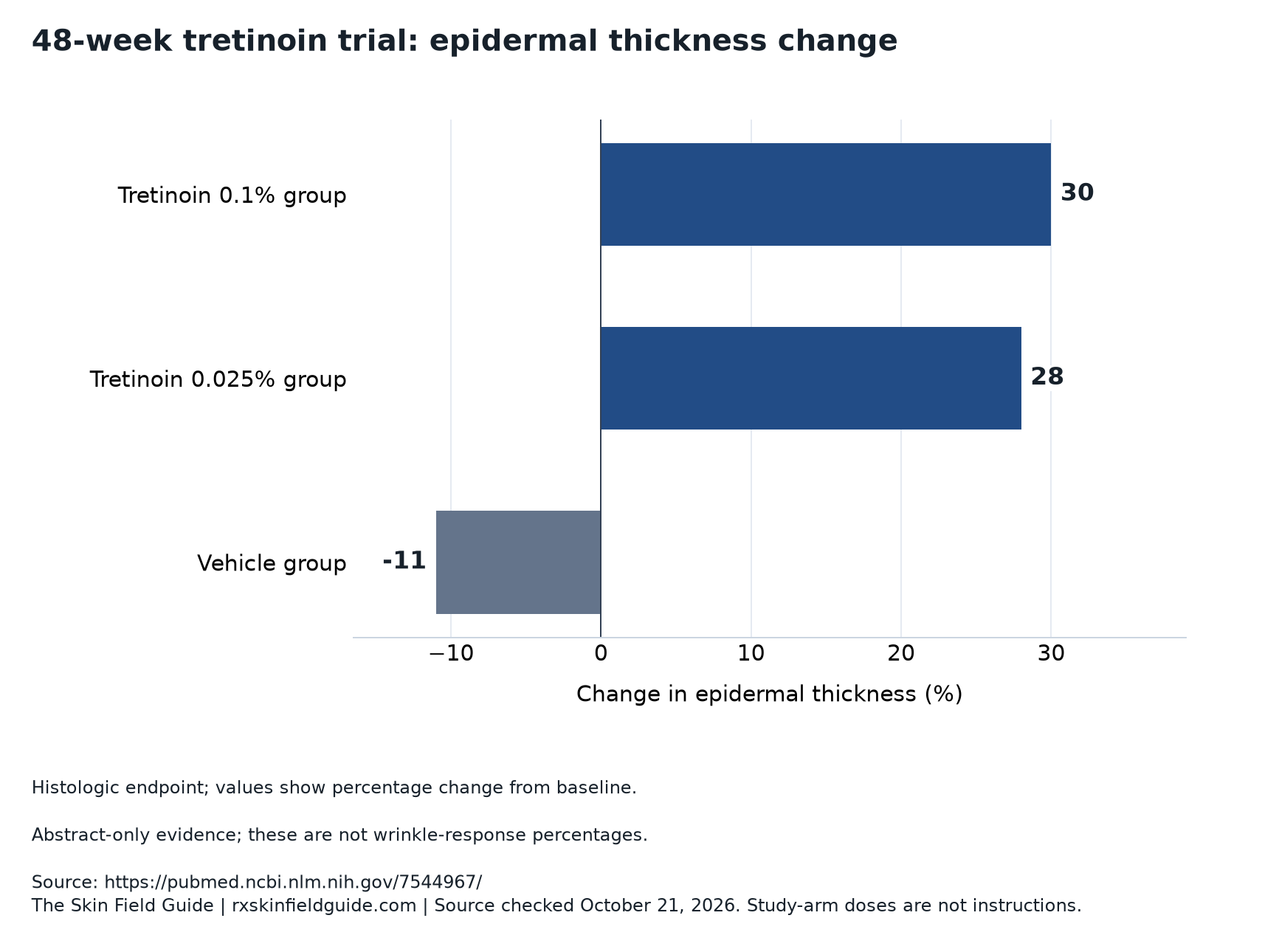
48-week tretinoin trial: epidermal thickness change
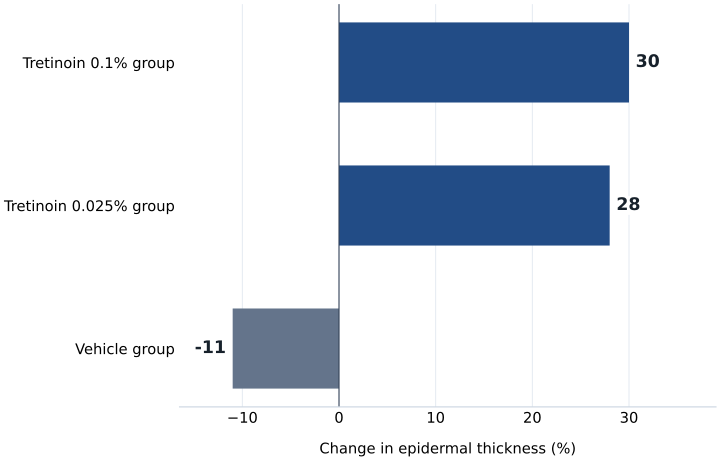
Histologic endpoint; values show percentage change from baseline.
Abstract-only evidence; these are not wrinkle-response percentages.
Download the source-labeled chart (PNG) · Download the data (CSV) · Download the chart (SVG)
| Study group | Reported value |
|---|---|
| Tretinoin 0.1% group | 30 |
| Tretinoin 0.025% group | 28 |
| Vehicle group | -11 |
Sections in this article
Find the people represented at the endpoint
The indexed 1995 abstract describes 99 completers with facial photoaging: 32 using 0.1% tretinoin cream, 35 using 0.025%, and 32 using vehicle, followed for 48 weeks. Enrollment, allocation method and attrition are unreported in the abstract.
A completion count answers how many people reached the reported finish. It cannot establish how many started or why anyone might have left. Imagine, purely illustratively, two studies each reporting 60 finishers. One might have enrolled 60 people and another 90. Their endpoint sample sizes would match, while their follow-up histories would pose different questions. Neither imagined history should be assigned to this paper.
Selection matters because an endpoint can summarize only the observations included in it. If unavailable outcomes were systematically different from observed outcomes, an analysis restricted to available measurements could give a distorted picture. Establishing whether that happened requires the missing records and analysis rules. An age category, a diagnosis and a completion count are therefore separate pieces of study description. The methodology page provides a place to distinguish a documented detail from an assumption made to fill a gap.
Locate the contrast inside the cream comparison
The report describes double-blinding. Blinding is intended to limit the influence of treatment knowledge on behavior and assessment. It does not establish random allocation, complete follow-up or perfect concealment throughout an experiment. These design features address different possible distortions. Inferring one from another would replace an unanswered methodological question with an unsupported assurance.
A vehicle comparison asks what changes when an active ingredient is added to a treatment base under the conditions being studied. An active-strength comparison asks a narrower question about alternatives that both contain the ingredient. Those contrasts need separate interpretation: evidence that an active treatment differs from its vehicle does not determine how two active strengths differ from one another. Nor does it isolate every property of a cream's formulation.
Consider a hypothetical experiment in which an evaluator knows which face received the stronger preparation. Expectations could influence a subjective rating even without deliberate favoritism. Concealing treatment identity aims to interrupt that pathway. Standardized lighting, rating instructions and repeatable measurements would address other pathways. This is why a useful study description names the comparison and measurement procedures rather than treating a single design label as a complete quality score.
| Question | Information that would answer it | What another design feature cannot establish |
|---|---|---|
| How were groups formed? | The allocation procedure and its implementation | Blinding alone does not establish random assignment. |
| How was appearance judged? | The rating scale, evaluator procedures and assessment schedule | A participant count does not define the endpoint. |
| Whose measurements were analyzed? | Analysis membership and rules for unavailable observations | A study duration does not establish complete follow-up. |
Attach a physical meaning to the percentage
On histology, active arms increased epidermal thickness and vascularity, whereas the vehicle arm decreased. Histology examines tissue features. Its measurements should retain their tissue labels when presented beside a clinical appearance assessment. Otherwise a number can quietly migrate from one endpoint to another, acquiring a cosmetic meaning that the measurement itself never supplied.
For an illustrative calculation, suppose a laboratory measurement rises from 40 to 50 arbitrary units. The increase is 10 divided by 40, or 25%. That calculation says nothing about whether a wrinkle rating changed by a quarter. It also does not mean that a quarter of participants improved: a change in a measured quantity and a proportion of people are different statistical objects. These invented numbers explain the arithmetic only.
A baseline also matters when comparing percentages. A small starting value can produce a large relative increase after a modest absolute change. To evaluate the biological interpretation, ask what was measured, how reproducibly it was measured and how it relates to the clinical outcome. Two endpoints moving in favorable directions can support a coherent account of treatment activity without establishing that one caused the other. A shared observation period is not a demonstration of a causal pathway.
Keep a missing difference separate from equivalence
Both active creams improved overall facial photoaging against vehicle, without a significant difference between active strengths. The active comparison's confidence interval is absent from the abstract. A significance result alone does not show the range of differences compatible with the measurements, making the size and precision of the contrast essential unresolved questions.
An illustrative example shows why precision matters. Suppose an estimated difference between treatments is one point on an invented scale. An interval running from minus one to three points leaves different possibilities open than an interval from minus nine to eleven. The same central estimate could accompany either interval. Neither interval belongs to these trials; they demonstrate why a point estimate and its uncertainty should travel together.
Formal equivalence requires a justified margin defining how much difference would count as acceptably small, followed by an analysis that tests that question. Choosing a margin after seeing a favorable result would change the evidential problem. A conventional comparison instead asks whether the observed data provide evidence of a difference under its statistical assumptions. That distinction preserves the useful finding without promoting a failure to detect separation into proof that treatments are interchangeable in every setting.
Treat irritation as an outcome with its own explanation
Erythema and scaling were greater with the higher concentration. Erythema means redness; scaling describes visible shedding. A tolerability outcome belongs beside the efficacy analysis because discomfort and appearance improvement are distinct consequences of treatment. Combining them into an undefined judgment that a product is better would hide the separate quantities a reader needs to evaluate.
The methodological question is whether irritation explains benefit, accompanies benefit or reflects another treatment response. A concentration comparison can reveal patterns consistent with these possibilities, but identifying a mediator requires more than observing two outcomes. A mediator is an intermediate step in a causal chain. Its timing, measurement and relationship to other influences matter; an association alone does not establish that intervening on the symptom would change the clinical effect.
It would therefore be a mistake to treat redness as a meter that reliably displays treatment success. The opposite universal claim, that irritation never participates in any relevant biological process, would also exceed this comparison. A more useful question is what additional measurements could distinguish the competing explanations. Repeated symptom and clinical assessments, exposure information and a prespecified causal analysis could sharpen that question without turning an observed pattern into individual treatment instructions.
Read longer observation as a different experiment
A separate randomized study involved 204 people with moderate to severe facial photodamage, comparing 0.05% tretinoin emollient cream with vehicle for up to two years. Its abstract reports improvements across clinical measures but gives no numerical clinical effect sizes or confidence intervals. A procollagen marker increased at month 12; the reported histologic comparisons found no increase in specified atypia measures.
A longer study can address persistence during observation, the timing of responses and effects that may take longer to detect. It does not automatically extend another study's result. A different preparation, population or assessment procedure changes the experiment. To combine findings quantitatively, an analyst would first need compatible outcome definitions, comparable follow-up windows and sufficient numerical reporting to represent each estimate and its uncertainty.
A tissue marker offers information about a measured biological process; it is not a substitute for a clinical event that was never evaluated. Likewise, absence of an increase in a specified microscopic abnormality does not establish protection against every future disease. In the mature-skin reference, an age-related concern is an organizing category. In an experiment, duration, eligibility and the exact endpoint must remain separate variables rather than becoming a broad assurance about long-term outcomes.
Move from the face to paired arm sites carefully
The retinol trial enrolled 36 people averaging 87 years, all white with phototypes I–II. It randomized 0.4% retinol lotion and vehicle to opposite sun-protected upper inner arms. Twenty-three completed 24 weeks; three withdrew because of cutaneous symptoms. Missing follow-up used last observations carried forward. Mean fine-wrinkling score changes were −1.64 versus −0.08 points on a 0–9 scale (P<.001).
Pairing sites within a person allows each participant to contribute a treatment comparison. This can reduce the influence of characteristics shared by the two sites, while requiring an analysis that respects their relationship. Counting each arm as an independent participant would discard that relationship and misdescribe the amount of independent information. The retinol study analysis examines this experiment in its own setting.
Carrying a previous observation forward keeps a participant represented by an earlier measurement; it does not create a newly observed endpoint. The assumption becomes consequential if a person's subsequent trajectory could have changed. Moving from this paired experiment to a facial concentration question also changes ingredient, skin site and population together. A difference between studies therefore cannot isolate which of those features accounts for a difference in results. That would require a comparison designed to separate them.
Match a labeled claim to the particular formulation
Current RENOVA labeling concerns 0.02% tretinoin cream as an adjunct for mitigating fine facial wrinkles alongside comprehensive skin care and sun avoidance. It does not claim wrinkle elimination or repair of photodamage. Local irritation and sun sensitivity are relevant warnings; pregnancy or attempted pregnancy precludes use. This labeled formulation differs from the study creams discussed above.
A product name, ingredient and concentration are separate identifiers. Matching only one leaves unresolved whether the preparation, intended outcome and evidence apply. A label also serves a different purpose from a research abstract: it defines the authorized product information and its boundaries. A paper may help explain a scientific question without expanding another formulation's labeled indication. The RENOVA review offers a route to examine the product record alongside that distinction.
For editorial comparison, write the proposed claim in full before deciding what supports it. A claim about a particular facial appearance measure needs evidence for that measure and formulation. A claim about all signs of aging would require a much wider set of observations. Broad wording can create an apparent contradiction between a positive research result and a narrow label when the two records actually address different questions. Careful matching avoids treating every percentage of the same ingredient as the same intervention.
Read the uncertainty attached to a table or figure
The retinol paper's clinical table uses 95% confidence intervals; its clinical figure uses standard errors. These are different descriptions of uncertainty and should keep their labels. A confidence interval concerns estimation under statistical assumptions. A standard error describes the estimated variability of an estimator across repeated samples; neither is simply the spread of individual treatment experiences.
Intervals for two separate means also do not, by themselves, provide an interval for their difference. In a paired study, the relationship between the two measurements contributes to the uncertainty of the contrast. Subtracting the lower endpoint of one interval from the upper endpoint of another does not reconstruct the appropriate paired analysis. A displayed result can therefore be informative while still omitting a quantity needed for a more detailed comparison.
Before comparing two plotted bars, identify whether they describe an endpoint value, a change from baseline or a treatment contrast. Then identify the units and observation time. A visually similar gap can mean different things under each definition. The table below turns that reading process into specific questions. It is an interpretive aid, not a replacement for results: an unanswered cell should remain unresolved rather than being supplied through arithmetic on incompatible summaries.
| Displayed quantity | Details needed before interpretation | Invalid shortcut |
|---|---|---|
| Change from baseline | Measured variable, units, baseline definition and observation time | Calling every percentage a percentage of wrinkles removed. |
| Two treatment means | Group definitions, analysis population and uncertainty of the contrast | Treating separate confidence intervals as a complete between-treatment analysis. |
| Repeated or paired observations | Which measurements belong to the same person and how dependence was analyzed | Counting each measurement as another independent participant. |
| An adverse-reaction count | Reaction definition, people assessed, collection period and whether categories overlap | Adding symptom counts and calling the sum the number of affected people. |
Keep the research record connected to the claim
Access for this analysis comprises the indexed abstracts of the two tretinoin trials, the full publisher retinol article with its original clinical table footnote, and full current RENOVA labeling. The retinol disclosure identifies four authors as inventors on a patent application, with conditional royalty interests. It does not establish that royalties were paid. No separate funding statement was located there; the tretinoin abstracts do not establish funding.
Disclosure is one part of interpreting a study, not a numerical correction to its results. A documented interest helps readers identify a possible influence worth considering alongside design, measurement and reporting. An affiliation or product name cannot fill in an undisclosed funding arrangement. Conversely, a missing statement should remain missing information rather than becoming a claim that a study had no sponsor. The site's coverage record provides context for the publication's documentary scope.
The same discipline applies when moving from research to a service page. Readers consulting the Curology review or Dermatica review can examine documentary terms separately from trial findings. These links make no claim that a service provides a studied preparation or reproduces its outcomes. My editorial interpretation is that a useful comparison keeps three records distinct: what an experiment observed, what a product's documentation states and what a service's terms describe.
Questions about the evidence
Which skin detail matters first when comparing studies?
Start with the actual site and condition being evaluated, then ask how they relate to the proposed claim. Two studies can both concern aging while investigating different tissue settings. Location is part of the experiment's definition, not a detail that disappears because the interventions belong to a familiar ingredient family.
Can a completion count be used to calculate a dropout rate?
Only with the appropriate starting denominator and a clear definition of completion. The calculation requires information about who entered the relevant follow-up group and who did not finish it. Guessing the starting count from the number at the endpoint would manufacture the missing part of the calculation.
Does an impressive tissue percentage quantify visible improvement?
Its meaning stays attached to the tissue variable measured. Connecting it to appearance requires evidence linking the measurements, not simply relabeling the percentage. A tissue endpoint may help investigate biological activity while leaving the size of the visible clinical change unresolved.
Why not select a concentration using one significance result?
A significance result addresses a defined comparison under particular assumptions. It does not combine effect magnitude, uncertainty, tolerability, formulation differences and an individual's clinical circumstances into a prescribing decision. Reading those components separately is a more accurate use of the evidence than turning a statistical threshold into a concentration recommendation.
Does full-text access remove every uncertainty?
No. It permits closer examination of methods, tables and disclosures, but cannot supply measurements investigators did not collect or reporting they did not provide. The appropriate question becomes more specific: which uncertainty was resolved by the additional material, and which still needs another analysis or a different experiment?
Editorial assessment
A strong reading of concentration evidence preserves the path from participant to skin site, measurement and comparison. It keeps clinical appearance, tissue findings and tolerability available as separate results rather than compressing them into a single verdict. The most useful next question is often precise: the uncertainty around an active-treatment contrast, the handling of an unavailable endpoint or the applicability of a formulation. Those questions make a study informative without asking it to answer a broader clinical or commercial claim than its design supports.
Research access and limitations
This is an interpretation of published evidence, not an individual prescribing assessment. Access differed by source as described above. Unreported details remain unresolved; illustrative calculations are not reconstructed trial data. No protocols, supplements or participant-level data were reviewed. Study populations, formulations, skin sites and outcome definitions constrain comparisons.
Sources and access notes
Sources checked October 21, 2026. The access notes below identify the material examined for this article.
- Two concentrations of topical tretinoin (retinoic acid) cause similar improvement of photoaging but different degrees of irritation. A double-blind, vehicle-controlled comparison of 0.1% and 0.025% tretinoin creams.
Indexed original research abstract · Checked October 21, 2026
- Improvement of naturally aged skin with vitamin A (retinol).
Full publisher research article, including original clinical table-image footnote, figure captions, Comment and Financial Disclosure; no supplements or individual data reviewed. · Checked October 21, 2026
- DailyMed - RENOVA- tretinoin cream
Official current labeling retrieved in full · Checked October 21, 2026
- Long-term efficacy and safety of tretinoin emollient cream 0.05% in the treatment of photodamaged facial skin: a two-year, randomized, placebo-controlled trial.
Indexed original research abstract · Checked October 21, 2026